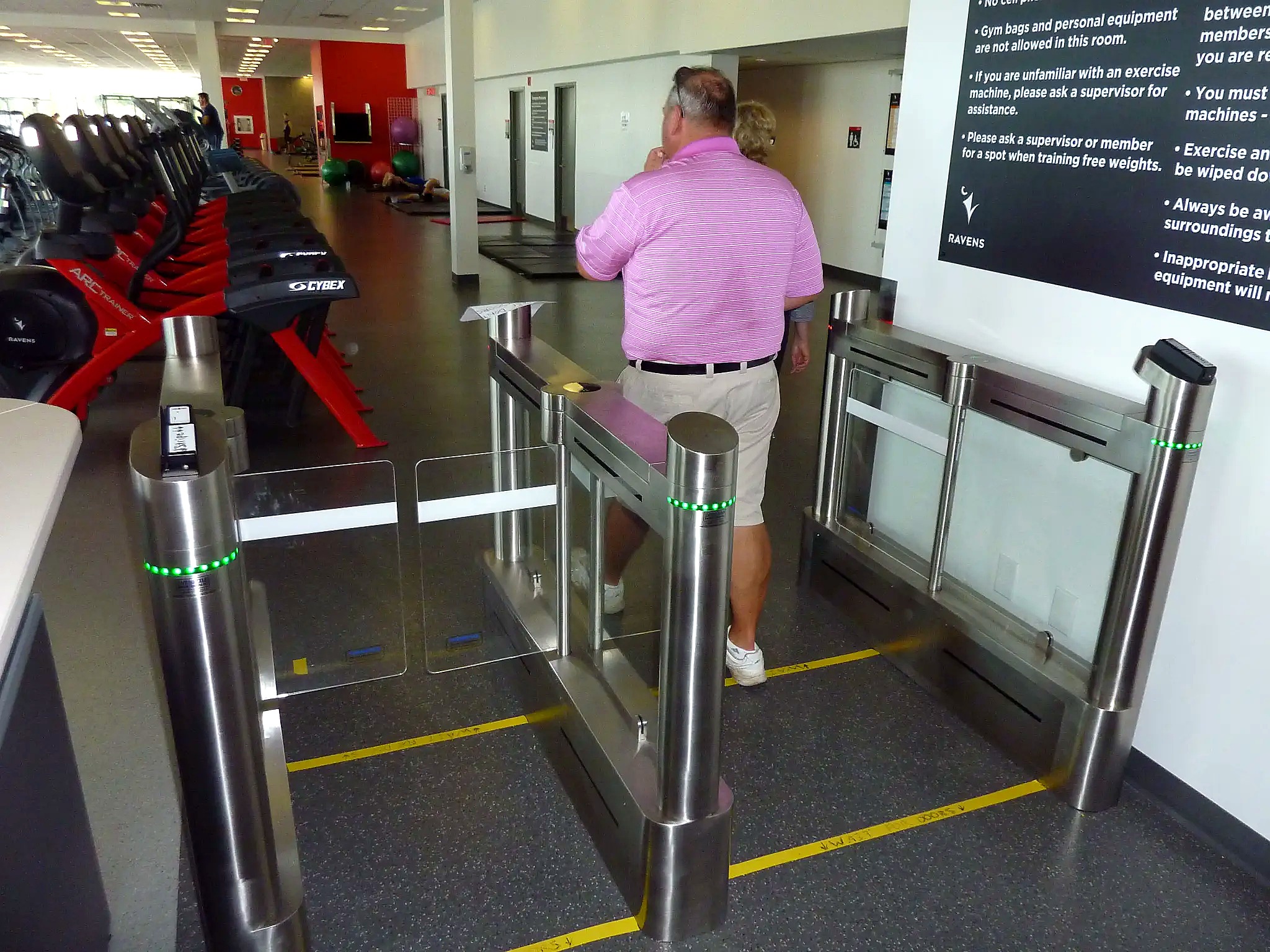
Turnstiles and security gates are access control devices — but they are also, by definition, obstructions in the path of egress. This creates a fundamental tension between security and life safety that must be resolved through careful product selection and installation. NFPA 101 (Life Safety Code) and the International Building Code (IBC) provide the framework for resolving this tension, and non-compliance can result in occupancy permit revocation, fines, and — most critically — loss of life in an emergency.
KEY NFPA 101 REQUIREMENTS FOR TURNSTILES
- Fail-safe operation: Gates must automatically open on power failure or fire alarm activation
- Maximum egress force: No more than 50 lbs to open in emergency egress mode
- Breakaway panels: Glass or acrylic panels must break away under emergency pressure
- Egress capacity: Total width of all gates must meet minimum egress capacity calculations
- Emergency override: Manual override capability for security personnel
- Signage: Emergency egress signage must be visible from all approaches
THE FAIL-SAFE REQUIREMENT: NON-NEGOTIABLE
The most critical requirement is fail-safe operation. In the event of a fire alarm activation or power failure, all turnstiles and security gates in the egress path must automatically open and remain open until the emergency is resolved. This is not optional — it is a fundamental life safety requirement that cannot be waived or modified.
Turnstile Security Systems' products include factory-installed fail-safe mechanisms that are independently tested and certified to NFPA 101 requirements. Every installation includes a compliance certificate documenting the fail-safe specifications, which is required for building permit and occupancy certificate applications.
"A turnstile that blocks emergency egress is not a security device — it is a liability. Every product we install is certified to open automatically in an emergency, without exception."
— Turnstile Security Systems Technical Director
EGRESS CAPACITY CALCULATIONS
NFPA 101 and the IBC require that the total egress capacity of all exit lanes must be sufficient to evacuate the maximum occupancy of the space within a defined time period. For turnstile installations, this means the aggregate width of all lanes (including ADA lanes) must meet the minimum egress width requirements for the occupancy load.
- Calculate maximum occupancy for the space being protected
- Determine required egress width per NFPA 101 Table 7.3.3.1
- Ensure total gate width meets or exceeds required egress width
- Include ADA lanes in egress capacity calculations
- Document calculations for building permit application
- Have calculations reviewed by a licensed fire protection engineer
GET NFPA/IBC COMPLIANT TURNSTILES INSTALLED BY CERTIFIED PROFESSIONALS
Get a free, no-obligation quote from Canada's trusted access control experts.
Request a Free Quote