Canada's retail sector is facing an unprecedented theft crisis. According to the Retail Council of Canada, organized retail crime and opportunistic shoplifting now cost Canadian retailers over $9 billion annually — a figure that has grown every year for the past decade. In the United States, the National Retail Federation reports losses exceeding $45 billion in 2024 alone, with an 18% year-over-year increase in shoplifting incidents and a staggering 28% rise in organized retail crime.
Traditional deterrents — security cameras, loss prevention officers, and electronic article surveillance (EAS) tags — have proven insufficient against increasingly sophisticated theft operations. The industry is now turning to physical access control, specifically exit gates and turnstiles, as the most effective frontline defense against retail shrinkage.
WHY PHYSICAL BARRIERS OUTPERFORM SURVEILLANCE ALONE
Security cameras and EAS systems are reactive technologies. They document theft after it occurs, or trigger an alarm that can be ignored. Physical barriers are fundamentally different: they require a positive action to bypass, creating a real deterrent rather than a passive record. Research from the Loss Prevention Research Council confirms that visible physical barriers reduce opportunistic theft by deterring would-be shoplifters before they even attempt to steal.
"Physical barriers are the single most effective deterrent against opportunistic retail theft. When a customer sees a gate, they understand that exit without authorization is not possible."
— Dr. Read Hayes, Loss Prevention Research Council
HOW EXIT GATES WORK IN RETAIL ENVIRONMENTS
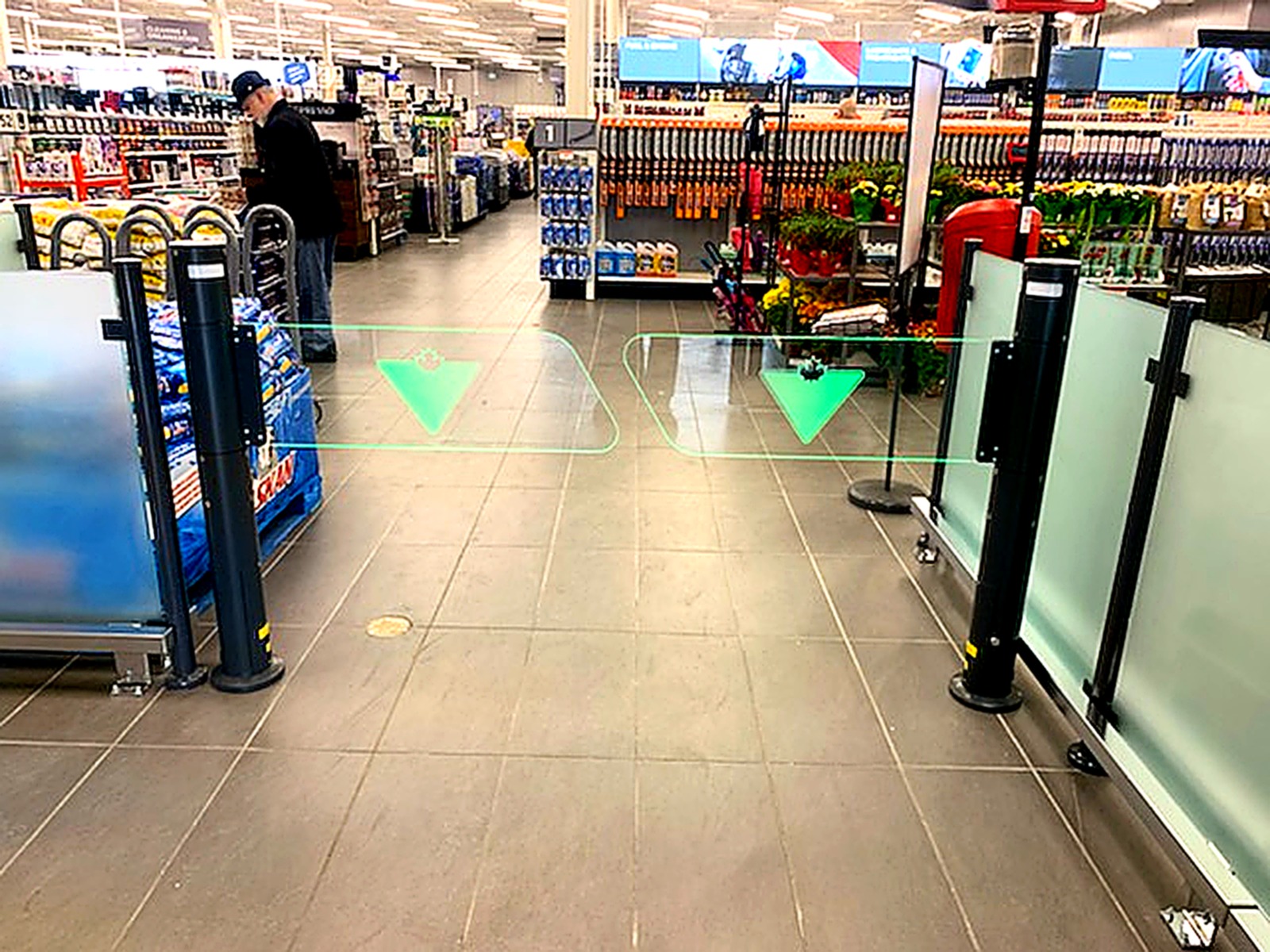
Modern retail exit gates integrate directly with point-of-sale systems. When a customer completes a transaction, the gate receives a signal to open — either automatically or via a receipt barcode scan. Customers who have not made a purchase must exit through a staffed lane or present their receipt for scanning. This creates a 'paid exit' model that has been proven highly effective in high-shrinkage environments.
- POS integration: Gate opens automatically upon completed transaction
- Barcode receipt scanning: Customer scans receipt to exit
- Staff override: Loss prevention staff can manually open gates
- ADA compliance: Wide-lane accessible gates for all customers
- Emergency egress: Fail-safe open in fire/emergency conditions
- Real-time reporting: Every exit event logged with timestamp
THE NUMBERS: WHAT RETAILERS ARE SEEING
Retailers who have deployed exit gate systems report dramatic reductions in shrinkage. A 2023 study of 47 Canadian retail locations that installed exit gates found an average shrinkage reduction of 43% in the first year, with some high-risk locations seeing reductions of up to 60%. These figures align with international data from the UK, where the British Retail Consortium reported similar outcomes following widespread adoption of exit gate technology.
ORGANIZED RETAIL CRIME: A DIFFERENT THREAT
The 28% increase in organized retail crime (ORC) in 2025 represents a fundamentally different challenge than opportunistic shoplifting. ORC groups operate with precision, often using distraction techniques, coordinated exits, and even confrontational tactics to overwhelm store staff. Physical exit gates are particularly effective against ORC because they cannot be intimidated or distracted — they require a valid credential to open.
Several major Canadian grocery chains have reported that ORC incidents dropped to near-zero at locations with exit gate installations, as criminal groups shifted their operations to unprotected stores. This 'displacement effect' underscores the importance of industry-wide adoption of physical access control.
CHOOSING THE RIGHT GATE FOR YOUR RETAIL ENVIRONMENT
- Grocery & big-box retail: Wide-lane ADA swing gates with POS integration and barcode scanning
- Pharmacy & specialty retail: Optical turnstiles with glass panels for premium aesthetics
- Convenience & small-format: Compact waist-high turnstiles with RFID integration
- High-risk environments: Full-height turnstiles with video analytics integration
- Multi-exit stores: Networked gate systems with centralized management
PROTECT YOUR RETAIL OPERATION FROM CANADA'S $9B THEFT CRISIS
Get a free, no-obligation quote from Canada's trusted access control experts.
Request a Free QuoteCOMPLIANCE CONSIDERATIONS FOR RETAIL GATES
All retail exit gate installations in Canada must comply with AODA (Accessibility for Ontarians with Disabilities Act) requirements, which mandate barrier-free access for customers with disabilities. This means every gate installation must include at least one ADA/AODA-compliant wide-lane gate with a clear passage width of at least 36 inches and an operating force of no more than 5 pounds. Failure to comply can result in penalties of up to $100,000 per day in Ontario.
Additionally, all gates must comply with NFPA 101 (Life Safety Code) and the International Building Code (IBC) for emergency egress. This requires fail-safe operation — gates must automatically open in the event of a fire alarm or power failure. Turnstile Security Systems' products include factory-installed fail-safe mechanisms that meet all applicable codes.